
I can’t judge her. I admire her for having the courage to talk about it and opening herself to the judgement of others.
Tag: carers
Revealed: the hidden lives of the UK’s 6.5 million carers | Tom Seymour
The Fear
The Fear. I hate The Fear. I have The Fear now and I don’t know what to do about it. More accurately, I don’t know what to do about what’s causing The Fear. So, as famous people take to Twitter, I’m taking to Tumblr in a bid to make sense of it all in my head. You can have a read, if you like.
MW is in hospital. She was taken in on Friday with a temperature of 39.8, rapid breathing, and a lot of confusion. The district nurse who saw her said she’d be better off in hospital where she could be given IV antibiotics. Tests showed another UTI, and two patches of what appeared, to the doctor, like cellulitis (which is new to MW). I’ve seen her in some states thanks to MS but this seems different. She seems more distant, more disorientated. As I’ve written before, MW has shown signs of dementia-like cognitive impairment – memory lapses, confusion, and so on. I know that infections will exacerbate any pre-existing cognitive impairing. It’s just that she seems so frail along with it. I was feeding her a bun and a drink tonight and had to remind her to swallow. She didn’t seem to know that I was trying to give her some food/drink, even though she’d agreed to have them. I don’t know what part of this is due to the infection (presumably reversible with medication and care), what is caused by the MS (more damaging and potentially more permanent), or whether it’s a mixture of the two (and will that part caused by the temporary infection become a more permanent part of her MS). Frustration leads to attempted rationalisation of what’s going on, which leads to The Fear.
MW was asking about her Mum coming to visit her, so I explained why she couldn’t. We live at the opposite end of the country from her parents, but it’s mostly due to her Dad being ill and that her Mum cares for him. This is not news to MW but tonight she seemed to get quite upset by it, which is very unlike her. She normally understands the situation surrounding her Dad, yet it was as though she’d forgotten all about it. I told her that her Dad’s very ill, which seemed to upset her. I tried as best I could to put a positive slant on things, telling her that they’re doing their best and that they’re winning but she still looked quite teary. I was telling her that she was winning too and that we’d get her right, and back home – trying to instil a spark of determination in her – which seemed to work. In truth, I was trying to blink back my own tears.
Which brings me to The Fear. I have the fear of losing her. Not just in the sense of her not being the same person as she once was – mentally, I mean. But also losing her physically, really losing her. Dying. A feeling not helped by the nurses performing ECGs on her due to a raised heart rate. With it being Easter, and staffing levels being low, there was no doctor around tonight to ask for an opinion or to ask to expand on their reasoning behind the tests. The nurses are asked to do the tests, not to evaluate the results and explain them to an anxious husband. I came away from the hospital at end of visiting time feeling very uneasy.
So, I’m lying here at gone 2 a.m., watching fuck-knows-what on TV, trying to make sense of it all (getting more frustrated by the minute that I can’t contact the MS specialist nurse for another 36 hours at the earliest – thanks a bunch, Easter), and trying to keep The Fear away. I know where The Fear leads if unchecked – panic attacks, anxiety, deep depression. And I really have The Fear of The Fear.
Confession.
Forgive me, Tumblr, for I have sinned. It’s been two months since my last post session. And woe betide any Tumblr that isn’t updated regularly.
I’m not clearing the path for an announcement that I’ve suddenly had a conversion to faith. I haven’t. I’m a quiet atheist. Which is to say, if you have a faith, good for you. I don’t share it but I won’t have a dig at you about it. I don’t believe in spirits, ghosts, fairies, etc. either. Which is a good thing because MW has had more ‘sightings’ of things/beings that has unnerved me a bit. Not in the sense of “what might there be in the house?” but in the sense of “what effect is MS having on her?”. When you’re asked to “stop the dead people from moving me and picking at my sore”, it’s hard to know how to react. I don’t want to make her feel stupid or humiliate her – these things are evidently very real to her. But I can’t help her with what is plainly not there. All I can do is reassure her that she’s not being moved, there’s no-one picking at her sore, and there’s no-one/nothing in the house that has any intent to harm her. So far, she’s believed me. What’s caused her to see these things? I have no idea. She does have a susceptibility to urinary tract infections, and she had one earlier this year. But the frequency and repetitiveness of the sightings can’t be down to just that. My next guess is that they are either side effects of the interstellar array of pain medication she’s taking or there are MS lesions affecting some part of her brain that is responsible for governing her perception of reality. I had a chat with the MS nurse. She reckons that side effects would be a likely explanation. Right now, the benefits of the medication outweigh the risks of the side effects, so we carry on.
Other issues include: an overzealous care company employee who looked to impose a hospital bed on MW. Apparently, the bed’s too high and is causing problems for one of the carers. None of the carers had mentioned this to me, nor had they written about it in the daily log. My insistence that current sleeping arrangements are more than adequate was met with, “I’ll have to take this to social services as a ‘safeguard’ issue”. This sent me into a bit of a spin. The idea that, out of the blue, someone can, de facto, impose a change on your living arrangements with little or no regard for how it would affect you is pretty frustrating. I suggested a compromise but that was refused by said minion. A compromise that was accepted following lengthy consultation with social services and an occupational therapy visit. In future, I’ll be extra careful of the influence of care companies.
Right, I’m off to do my Tumblr penance. Go in peace.
It’s a 24 hour thing.
This caring malarkey is a 24 hour thing, and the last 24 hours have been…challenging.
19:15 – I notice MW’s catheter isn’t draining, which is not unusual but it’s happened three times this month, which *is* unusual – so, I start doing what I can to help. By this I mean I changed the bag to get rid of any blockages there, rolled MW a couple of times to see if a positional change would make a difference, and gave the tube a gentle wiggle at its entry point into her abdomen to see if that helped. No change.
20:00 – I ring district nurse (DN) overnight team. They arrive about 15 mins later and try (not that hard, it has to be said) to change the catheter. They can’t do it. MW must go to hospital. As she has this grade 4 pressure sore on her bum, she needs an ambulance to be able to transport her safely – besides, the DNs had left the catheter in but had left it unstable. Apparently, this meant that there could be an eruption at any point, given the right circumstances. Lovely. So, they call a non-emergency ambulance – it’ll be with us “within the hour”.
02:00 – Following three phone calls assuring us we’d not been forgotten, the ambulance arrives. I carry MW off the bed and place her onto the stretcher, and she is taken to hospital.
By 05:10, an on call urology Dr had changed catheter twice (!) and MW had had two bladder scans performed. The catheter had been changed but wasn’t draining. Actually, this isn’t so unusual directly after insertion. I especially didn’t think anything untoward had happened given the time of night and the fact that MW had only had a small amount of liquid to drink. Dr gave the choice of staying until drainage begins or go home and if regular DN notices anything odd, back to hospital. MW says she wants to go home and an ambulance is arranged to bring MW home.
My Mum (who insisted on coming with us to the hospital because she “wouldn’t be able to sleep anyway”) was shattered so I brought her back home then drove back to hospital, ready to wait with MW until the ambulance is ready. When I get back to the room in A&E, MW has changed her mind and just wants to get back home to sleep. I get a nurse to bring a wheelchair. I lift MW off the stretcher onto the chair. While MW’s in my arms, the nurse notices that MW has messed and cleans her up. I get MW into the chair and the nurse takes her to the front of A&E while I get the car. I lift MW off the chair and struggle like hell to get her into the car. Nurse accompanying us to the door asks me “Do you do that every day?” "Erm… yes.“ "Oh my God, I’m filling up here watching you”. I have no idea what else to say. So, I thank her and drive home, doing all the lifts in reverse on arriving home. By now, it’s 0630, and I’m exhausted.
So, we’re at home and, after about 90 mins sleep, the regular DN calls with specialist wound nurse (TVN) for a scheduled visit to look at the sore. There’s still no catheter drainage. I explain to the nurses what happened overnight. I roll MW onto her side so the TVN can inspect the pressure sore and change the dressing and…
WE CAN SEE THE BALLOON END OF THE CATHETER STICKING OUT BETWEEN MW’s LEGS!
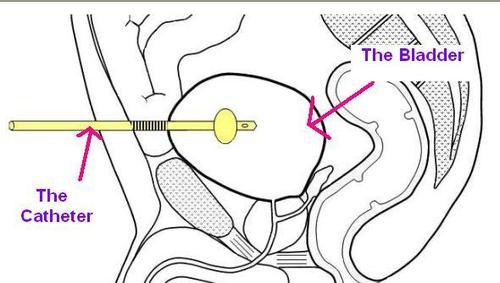
(Image from: http//www.registerednursern.com/wp-content/uploads/2008/10/supra-pubic-catheter.jpg)
The hospital Dr has inserted the catheter into the hole in her abdomen, kept pushing until the balloon on the end has come out of MW’s body, between her legs. (I’m sure you don’t need me to be any more graphic than that). The nurses are aghast. One of them had heard of this happening but had never seen it. The other was appalled. Fortunately, they were able to change the catheter properly with minimum fuss, and were kind enough to help me clean MW and the bed after it drained about a litre of liquid straight away.
Each of our gasts are well and truly flabbered at what happened. I am more relieved than angry (and tired) about it all. As of right now (01:06, 29/08), everything is still working well, and we’re all trying to catch up on sleep. I’ve napped through the day and hope to get a good 7-8 hours now.
There’s no 9-5 with being a carer – it’s truly a 24 hours a day job.
Feeding: a habit
No screed of a post this time, just me emptying my head into the void.
MW and I would usually join our old branch of the MS Society for their Christmas dinner. Not this year. As MW now needs to be fed more often, we’ve decided not to go. We both know that there will be other MS sufferers there who have to be fed but we’ll still not go. It’s one thing to have to have to be spoon-fed at home, it’s another to do it in front of 100-120 other people. It’s about dignity, I guess.
MW also has another pressure sore. What you may not know is that not only is a pressure sore very difficult to heal (a previous one took 5-6 months to fully heal) but skin breaks exacerbate other MS symptoms. We suspect it came from a blister caused by the hoist sling.
It’s odd how such small, innocuous things cause major problems.
What is a man?
What does it mean to be a man? A pointed question. One that’s likely provoked many an hour of chin-stroking in people far more learned than me. It feels pertinent to me as a carer. Whether other male carers feel the same, I can’t say. I can only say that the question lodges itself in my head from time to time and provokes a good deal of self-analysis.
Recently, I found myself listening to Woman’s Hour on BBC Radio 4. I’m not so narrow-minded as to assume “Ugh, women’s stuff – not for me.”, or that I couldn’t find it interesting, so I didn’t tune out. After a few segments, the programme featured an interview with Jody Day. Ms. Day has founded Gateway Women, and written a book, Rocking The Life Unexpected, both of which were inspired by her search for support whilst grieving at the realisation that she will never have children. I listened to her story and how she described her feelings and experiences as a woman at the time her peers were becoming mothers. She recalled feeling at odds with people around her, as though she was viewed with a little suspicion. Perhaps she wasn’t fulfilling the stereotypical role of “woman as nurturer/carer”. This caused my pointed question to lodge itself once again.
Ms. Day’s story touched a couple of raw nerves. 1. I am a carer. 2. I have no children and won’t be having any.
If a woman’s role in life is to be nurturer/carer (I don’t believe this to be true, by the way, but please bear with me for the sake of this post), then what role does a man have? What’s the male stereotype? Provider? Hunter/gatherer? And do I fulfil that role? While I see this stereotype to be as outmoded as the idea of a woman’s sole role to be a nurturer/carer, it doesn’t stop me from questioning my place in the world. A feeling similar to that described by Ms. Day. I sometimes wonder how people view me because of what I do for MW. I suppose it shouldn’t matter but it does. It’s important to me to feel like I fit in somewhere.
I grew up in a shipbuilding area during the 70s/80s. The “hunter/gatherer” stereotype was everywhere you looked; originating at home, and reinforced at school or with friends. Add the same messages from the media and you have a powerful influence around you. When I was a kid, I assumed this was the stereotype to follow. When I began my working life (albeit not in industry) and started having relationships, I still assumed that I would be the ‘hunter/gatherer’ – especially when I thought about marriage and a family in my future (more on this later). I didn’t foresee that the ‘role’ I would have in my 40s would be so different from that stereotype.
Prior to being a carer, I didn’t know a single male carer. None whatever. Of course, I do now. I’ve met quite a few, either in person or via Twitter. But prior to 2005, I had no concept of what it entailed to be a man who is a carer. It was a cultural role that never existed for me to learn about. It’s very rarely, if ever, covered in the media. I know there are occasional media references to men who are carers but their role in the cultural world around us is never explained. It’s as though they’ve just beamed down and started caring. I didn’t get beamed down. I’ve been through (and am still going through) a self-examination in terms of who I am as a man, similar to Ms. Day’s self-examination as a woman. I’m not the “provider” that I expected to be. I’m not going to go into detail about our financial affairs but our circumstances dictate that MW’s share of the household income is higher than mine. I am a full-time carer. A role that doesn’t appear to be valued too highly, regardless of gender. I am a male, full-time carer. I have assumed the nurturer/carer role that society appears to deem only suitable to women. Even anthropologists are making inferences to the size of caring males’ testicles!! (Don’t believe everything you read!) When I tell someone I’m a full-time carer, the reply tends to start with, “Oh…..”, followed by a pregnant pause. They’ve no frame of reference for meeting someone who has that role by circumstance rather than by choice, as a care-worker might. It’s as though what I do – and by extension, who I am – isn’t “natural”. I might as well be an alien, or a talking animal. So, what does this make me in the eyes of other people?
The second raw nerve was about children. The Women’s Hour interview continued, and referred to women who find themselves childless by circumstance. (That is, they’ve not actively chosen to be child-free.) This is a truth I’ve had to come to terms with myself. I don’t have any children, and I’m not going to have any. Both Ms. Day and the interviewer acknowledged that there are a number of men who find themselves childless but their experiences are different. She’s right. But it’s no less hard to come to terms with. Just as I’m not a carer through choice but by circumstance, so I’m childless in the same way. MW and I wanted to have a family. We tried for ages but it didn’t happen. Abortion has been part of both our lives so we assumed that there was no biological issue. We considered IVF. However, at that time, our energy was taken up coping with my Dad’s illness. MW’s symptoms began very soon after Dad died. The severity of MW’s initial MS relapse put a stop to our dreams at the time, and its ever-debilitating progressiveness has done the rest. Although we both know what the reality of the situation is, we don’t discuss it often, save for brief “I wish we could have been parents” conversations, prompted by a TV programme or seeing a cute child when we’re out. But these conversations never last long. Rationally, I realise that caring for MW is too demanding to consider adoption or fostering. But I feel very much unfulfilled as a man – a propagator of my species. The prospect of my genes dying with me leaves a visceral scar.
Meanwhile, all my friends have gone on to become parents. (MW’s friends have tended to be a bit older than her so the dynamic is a little different) Ms Day spoke about how she felt a greater distance from her peers as they all had a common thread that maintains their interaction – i.e. having children. I guess it comes naturally for parents to talk about their children: schooling, growth spurts, etc., even to strangers. Becoming a carer is a great way to lose friends. Not becoming a parent is another. I sometimes sense people my age struggling to talk to me once they ascertain that I don’t have children. It’s as though their entire catalogue of conversation is geared towards their children – either as a conversation starter or as a specialist subject to the exclusion of everything else. Since I don’t have children, it’s assumed I won’t have anything in common with them – which I find strange – so conversation stops. Perhaps I should turn the tables and act awkwardly towards non-carers? No, maybe not.
You might read this and say, “what does it matter what other people think?”. And you would probably make a very valid point. The thing is, I look at myself in the mirror sometimes and wonder how I match up against the archetypal male ideal (which may or may not exist) that society/media would have me measure myself against. I also wonder how other people score me against that same ideal. Not enough to keep me awake nights but I do think about it.
So, what does it mean to be a man? Maybe it’s all just bollocks.
Fear and self-loathing in the North.
I don’t really know where to go with this. But the last two weeks have been difficult to say the least. As I type this post, I can feel the urge to shut the laptop down and not write it. It’s embarrassing to write about. So the question is, why do it? Because I need to let it out. Because I’m tired of bottling it up.
I moved house two weeks ago, which isn’t an easy task. When you’re solely responsible for moving the lives of two people, it’s harder. There’s no-one to share the load with. I’ve organised everything: the new house itself, dealing with the housing association, removals, the packing, getting social services on-side, organising a new care team, new equipment, dealing with the old landlord (of which more, later), swap-over of domestic services, address changes….the list is a long one but it’s all been down to me. That’s just the way of things – it couldn’t have been any other way.
I’ve felt my stress levels rising rapidly (I can’t even write those words without feeling sneers of disapproval – don’t ask why or from who/where – I just do). I’ve been lucky insofar as I’ve had my Mum staying with us to help with the practical things.
It got to the point that, on moving day, I was sick of hearing my name and having someone “need” to have my input or approval. I was travelling between the new house and the old, overseeing everything the movers were doing, dealing with signing the agreements, everything. And in the quiet minutes, being a carer. And in the tiny cracks of time between that, being a husband – rather, trying to be. The panic attack I had should have sounded a warning bell but I had to keep going.
We’d been in the house three days when I was involved in a car accident. It’s in the hands of the insurers now which feels to me a little like it’s sub judice. Everyone involved was OK and MW wasn’t in the car at the time. It shook me like hell, and it’s been a grind dealing with insurers, garages, solicitors, the police. It’s something I could have done without. I could tell that I was in a bad way, mentally, but no-one can take over from me.
Another blow came the following day. Our old landlord sent me an e-mail which put me into a spin. He’s sought to keep the bond we left, giving the most flimsy reasons for keeping it and ensuring that we’d need to fight for it by legal means. This, along with the fall-out after the car accident was all I could take. At first, I was just numb. Working on auto-pilot. But, at the beginning of last week, I was in a bad way. Crying all the time. Worrying about everything. Scared of everything. Tired of all the responsibility.
I was thinking things that I’ve thought before and they scared me. I just wanted to say “make sure that MW is looked after” and disappear. I didn’t even know what I meant by that, only that I didn’t feel worthy of being around. I don’t just mean unworthy of being in this place – the new house – at this time. I mean unworthy of being anywhere. That I’d made people worry, that I’d disappointed people. That I’d let everyone down, especially MW.
My Mum was about to go home (to be fair, she’s been here for about two months now) but I had to ask her to stay a little longer. I suspect she could tell by my behaviour that I was in a bad way. Fortunately, she agreed. She’s still here. I don’t know where I’d be if she wasn’t.
I’m tired. I’m not sleeping properly or feel like sleeping half way through the day. I’m still crying but not as much. And I’m still scared. Still fearing the phone ringing, the post arriving, wondering where the next setback’s coming from.
Anyhow, this post’s rambling about with no real focus. Which is pretty much where I’m at right now. Rambling about trying to keep going as best as I can. But it’s a struggle.
Life’s hard.

I’ve not blogged for a while as I’ve been moving house and crashing the car. In the same week. No injuries though and MW wasn’t in the car at the time. Maybe I’ll explain more in a future post – this post is really meant to keep the blog ticking over.
The new house is an adapted bungalow with the facilities MW needs to live day-to-day. It’s very good and we’re just getting to grips with everything it has to offer.
I now live in a community that has a few residents with disabilities. My immediate neighbour is a man who suffered a stroke and is now reliant on his wife to care for him. He uses an electric wheelchair to get about. He can’t be more than 5 years older than me.
Another neighbour, who’s lived here for 10 years or so, had an accident. I say accident, he was pushed off a bridge onto concrete. He broke just about everything and was in a coma for 9 months. He told me that he’s still determined to walk. He, too, uses an electric wheelchair to transport himself around and I’d say he’s younger than me.
There’s no inspirational motive for this post – no ‘moral to this story’. I merely observe that life’s bastard hard on some people.
This is the reality – a post written for Carer’s Week.
I was asked by the organisers of Carers Week 2013 to write a blog post for their site based on the subject of being “Prepared to Care”. I’ve reproduced it here (for no other reason than to keep the blog ticking over).
11 other carers wrote their stories about caring for the same site. Please take the time to go and have a read. Every carer’s experiences are different and it was educational for me to read their accounts of being a carer.
Meanwhile, here’s my post on the financial aspects of being a carer.
Over the 8 years I’ve been caring for my wife, I reckon I’ve lost over £175,000 in income (give or take a promotion or three) and as a couple, the figure reaches well over £250,000. When my wife was diagnosed with MS in 2005, there was no independent financial adviser tempting us with a glossy brochure illustrating the potential losses that disability and caring can bring. No presentation slides and projections for the following 5 to 10 years. In fact, we didn’t even think about finances that much other than ensuring we could scrape enough together to cover our monthly outgoings.
If you can sense a little sarcasm in the above paragraph, you’re right. However, there is a kernel of seriousness in there as well. While there are a number of organisations who will help you with filling in forms for various benefits, none of them can adequately prepare you for not having anything like as much coming in as you might have had prior to taking on the caring role. Will you, the carer, be the ‘breadwinner’ where you might not have had this role before? Can you still ‘work’ while being a carer? The person you care for may have such extensive needs that ‘working’ is no longer possible. To suddenly go from not having to worry about bills to wondering if you’ll be able to get the shopping you need is a hell of a shock.
Why have I put quotation marks around the word “working”? Because, despite many speeches to the contrary from politicians of all flavours, caring isn’t viewed as real work. It’s just something you do that prevents you from doing real “work”, right? I can tell you from my experience that it’s bloody hard graft. Hard graft for little recompense. Carers are a conservative’s dream workforce. And, perhaps controversially, I’m not referring to care-workers. They’re different. While they may not be adequately recompensed for what they do, they’re entitled to minimum wage and health & safety protection. Carers have no employee rights, no health and safety enforcement, and all for £59.75 a week. If you provide care for a bare minimum 37 hours a week, this is £1.61 an hour. Obviously, that hourly rate reduces the more hours you care. I certainly do way more than 37 hours – and way more than the 48 hours specified in the European Working Time Directive. There’s no choice. Caring has to be done because the person you care for needs the help.
When you’re used to an income somewhere around average salary, a drop to Carer’s Allowance is a big shock. I was a Civil Servant. And it wasn’t just a job, it was a career. I’d been promoted a couple of times and was on the list for another. My wife was also ready for promotion. Then MS appeared out of nowhere. We’d spent the three years up to and including 2004 dealing with divorce, court cases, and helping with my Dad who had terminal cancer. 2005 was supposed to be the first year of our future. It turned out to be the first year of MS in our lives. And a pretty vicious, progressive form it is too. We were married in the January and by March the symptoms were really kicking in. Diagnosis came in May. Right from the off, my wife needed help to look after herself. We lived nowhere near family and couldn’t ask friends to do it. It was just us two. So I became her carer. Not a post I’d applied for. Not one she’d advertised. But that was the reality.
I had to stop “working” because I had to provide so much care for her. (The photo attached to this post is from 2006 – her MS has progressed considerably over the last 7 years.) Needless to say, my wife had to give up too. Overnight, our “earning” capacity dropped by over half. You learn pretty quickly to do without your disposable income. You learn, or at least I had to learn very quickly, that every penny has to be accounted for every month. That there’s no “fat” available. Your lifestyle has to change but, with disability and caring, your lifestyle is changed for you. Things like going out become a thing of the past, so you’re saving money there, right? You concentrate on keeping a roof over your head, putting food on the plate, and the home heated and lit. That’s it. The other stuff doesn’t exist any more.
Nothing and no-one can really prepare you for losing so much if disability should enter your life. Caring is the same. Your sense of worth is conditioned by society to be bound up in what your income is. You’re judged on it by the outside world, even if they’ve not met you – a cursory glance at today’s media will tell you that. And you certainly spend many a waking hour judging yourself on it. “Is this all I’m worth now?" Despite the occasional political speech or media article eulogising the work of carers whenever there’s an event like Carer’s Week, you can’t help but measure yourself against the bulk of the stuff you see in the media. Who’s got what? Who’s doing this and that? Where to go on holiday this summer? Etc, etc, etc. The Joneses are now a long way out of sight.
Think about your income. Think about what you might be doing with it over a weekend, over the summer. Then imagine over half of it gone. What would you do? This is the reality for a lot of carers. Would you be prepared to care?
 A Husband For A Carer