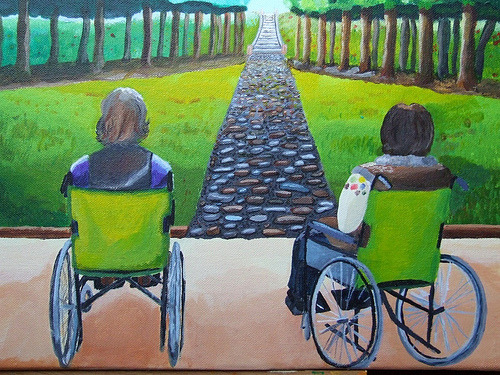
No glee, no win.

Something struck me today while having a coffee with a friend.  And that’s the effect on other people when I describe what happens in my and MW’s lives.  When I’m asked how things are going, I’m often torn as to just how much I say.  And I’m never quite sure just what to say.  I’m not going to lie about it, there’s no point in that.  Everything I say or write has been absolutely honest.  Which is my point.  It’s honest, but it’s grim.  Or, at least, it can be construed as grim by some.  Even skimming the surface of things can be unsettling.  

If I say that things are difficult, it doesn’t really explain anything.  So, I’ll expand on that.  Only slightly, mind.  MW is deteriorating, she’s losing feeling from the waist down (let alone lost movement).  She’s losing upper body strength and sleeps a lot.  The need for sheltered accommodation is very real now.  In our forties.  There you go.  What’s that?  *counts*  3 sentences?  3 sentences that give an idea of what’s going on but don’t delve too deeply.  Trust me, there is a lot more detail that I don’t talk about.  But when I say them (or write them) in response to being asked, “How are things?”, I get the impression that it’s an awful lot to take in.  And, I guess it is.  I see the person I’m talking to imagining how things are and how they’d deal with things in the same position – and that imagining is done in a split-second – and I see the realisation that it really is difficult.  I live with these circumstances every day so I’m hardened to them.  But I’m sensitive to the way others react when they hear (read) what’s happening here.  I don’t want to bring your mood down by telling you things.  I’m not going to lie to anyone though.

I’ve started pausing………………………..before answering the “How are things?” question.  Because I’m aware that the reply is a bit of an emotional hand grenade.  So, if you do ask me how things are, I’m not ignoring you – I’m just thinking of the best way to tell you without ruining your day.

End of an era…

Finding a carer that’s good to work with is difficult.  Not that there aren’t good careworkers out there – there are loads of them.  But it comes down to personality in the end.  Sadly, Maureen, the carer that’s worked with MW and me has decided to move on to pastures new.  I’m not going to say that it’s all been smiles and good times with Maureen.  Like all relationships, both personal and professional, there have been some arguments and spats, but we’ve worked through them.

I’ve already written about Maureen and how she’s helped us every morning.  She’ll probably not see this but I hope she’s happy in whatever she moves on to.  We’ll still see her occasionally – we may have lost a good carer but we’ve gained a friend, which is far more important!!

On a similar subject, a friend of mine on Twitter is delivering a eulogy at the funeral of a woman she cared for until her recent passing.  To have been given this honour speaks of the close relationship she had with the person she cared for.  I suspect it will be difficult but I hope there are more smiles than tears.

Love? Or break point?

Following on from my first post, and the responses to it, the prickly subject of relationships is in my thoughts.  I’m not going to gush about mine and seem all sanctimonious because that would give you a false image.  Let me give you two examples of relationships I’ve encountered or heard about.

  • A bloke I know, let’s call him W, looked after his wife, who had MS, until her untimely death a few years ago.  The actions of a man deeply in love with his wife and devoted to her throughout.  W now lives with his daughter trying to be as good a parent as he can, and does an incredible amount of good work for a local MS charity.
  • Another man I’ve heard of, who I’ll call J, cared for his wife, who has MS, for 10 years or so.  I know little more about him, save to say that it all got too much for him and he left his wife.  He took their children and left to be with another woman who he’d met on the internet.  J arranged for his wife to be accepted into a care home where she remained until quite recently.  She now lives in her own home with carers helping her.

At first glance, you can judge each of these two people.  W is a noble man, the kind of man who gets lauded as a role model, the man that makes women turn to their partners and say “why can’t you be more like him?”.  On the other hand, J is the worst kind of rat bastard who deserves ten kinds of pestilence to fall upon him.  Easy, right?  I disagree.

W is a good man, BUT… the man I see has been deeply affected by what’s happened to him.  He looks tired and stressed whenever I see him yet he maintains that he’s happy.  He’s happy with his very long distance relationship, he’s happy with his daughter now at college, he’s happy.  I don’t know W very well at all so he may well be as happy as he says he is.  But, to my eye, he looks like a man who’s seen and experienced too much and is trying to cope with it all.  Only he and those close to him can say with any certainty just how well he is coping.  To me, J started out with good intentions – you’re not a carer for 10 years if you’re an innate bastard.  He reached a point where he couldn’t take any more.  Could he have made his exit differently?  Maybe.  Who knows.

I’ve met or heard of many people who fit into both of these categories, one who stays with MS or one that runs away from MS.  Every person has a breaking point.  J reached his and nobody but him knows what it was that took him there.  I think that J saw himself as living with MS first and with his wife second, and that he left MS since MS wouldn’t leave his marriage.  Perhaps W didn’t reach his because destiny, nature, call it what you will, got there first.  Maybe his breaking point is occurring now and has been since his wife died.  All I know is that I think of both of these people in connection to my own relationships – both with my wife and with MS.  I’ve not reached my breaking point but living with MS is bloody hard.  As a carer it’s easy to find yourself increasingly living with the disease rather than living with your partner.  Did J leave his wife too early?  Should he not have recognised his breaking point?  Was he being selfish?  Why should he not have thought of himself and his own life?  Did W stay too long?  Is he aware of the effect that his experiences have had on him and his life and family?  Would he have been happier leaving and letting someone else deal with his wife’s MS?  

A carer’s feelings and suffering are generally considered as secondary to those of the person they care for.  Illnesses, diseases and disabilities have names and recognised symptoms.  A carer’s suffering remains unrecognised yet I see it as neither easier nor worse than that of the person cared for.  It is equal but very different.  I find that I can’t judge either of the men I’ve written about here because I don’t know if or when I’ll reach a breaking point.  And I don’t know that I want to either.

A painful post.

image

I must warn you that I have written this through blurred vision caused by a lot of tears.  It’s upset me a lot to write it because the subject matter means so much to me.  I’m not naive, I realise that other people might be upset by the subject as well.  This is your “look away now” warning.

I should also say that I don’t have a illness, disease or disability.  I am, however, the primary carer for my wife who has progressive Multiple Sclerosis.  I make this disclaimer to make clear that I have no first hand experience of what a disabled person goes through.  No matter what I witness, I don’t feel what a disabled person feels.

That said, I do have firm views on the issues surrounding disability and disabled people.  One of which is the issue I fear most – death.  More specifically, the prospect that my wife will feel so defeated by MS, in such despair and pain, that she wishes to end her life.  I am prompted to write this by two events: i) Monday 13th June marks the start of Carer’s Week 2011 and ii) as I write this, the BBC documentary on assisted suicide, made by Sir Terry Pratchett, has yet to be broadcast.

The publicity for this documentary has hit me very hard because one of the case studies to be featured in it concerns an MS sufferer who was roughly the same age as my wife when he chose to end his life at the Swiss Dignitas centre.  For those who haven’t seen the press coverage ( I don’t intend to repeat entire newspaper/magazine articles but here’s an example from the Daily Telegraph ), a 42 year-old MS sufferer, Andrew Colgan, chose to travel to Switzerland’s Dignitas centre with his mother and drink the poison that would end his life, and therefore his suffering.

My wife was diagnosed with MS in 2005.  Four months after we were married.  So far this disease has robbed her of her mobility, control over various body functions, her livelihood, in fact most of the things that the majority of people take for granted every day.  We’re both in our early forties and our friends have children of various ages.  This is another part of ‘normal’ life that is denied us.  It’s reported that Mr. Colgan had to “fall” out of bed in a morning and crawl around to move independently.  My wife can do neither of these things.  I must lift my wife out of bed onto a wheelchair, shower her, help her go to the toilet, lift her into a chair, off the chair, in and out of a wheelchair, into a car, out of a car, you get the idea.  She gets tremendous nerve pain in most of her body (although not at the same time) and painful spasms in her legs.  I must dress her, undress her, change soiled clothes, do all laundry, make her meals, get her drinks, feed her when she lacks the strength, prompt medication, take care of all affairs; and, when all this is done, I am also her husband.

I watch her face screw up with pain and hear her scream when I lift her.  ( Please don’t ask, “why don’t you have a hoist?” – this would provoke a diatribe that I don’t have the energy for right now )  Despite taking handfuls of painkillers and anti-spasm medication of varying hues, sizes and strengths, she still feels a lot of pain.  And every time I witness her in pain or lose control of a bodily function, I think to myself “is this the one?”.  Is this the occasion that flicks a switch in her mind to begin to feel that the struggle isn’t worth it.  Because I imagine that’s how it starts – that one instance of pain too far, that one loss of control that makes a sufferer think “That’s it. Enough.” albeit briefly.  And that thought intensifies with every subsequent episode until the sufferer starts to envision the practicalities of making it happen.  I have the utmost respect and admiration for Mr. Colgan’s mother who, not only accepted his decision to end his life, but travelled to Zurich with him to be there at the end.  To watch her son die voluntarily.  The bravery which she must have displayed to go with him to Switzerland is something I can only aspire to achieve every day.  I cannot, CANNOT countenance the idea of my wife wanting to kill herself.   And yet, despite my gut reaction, when I consider it rationally, I can only come to the conclusion that anyone who despairs of feeling intense pain and suffering must have the right to make this choice.

I don’t intend to watch the BBC documentary because, as I hope you can imagine, it covers a topic which is far too close to home.  As Carer’s Week begins on 13th June, my thoughts go to Mr. Colgan’s mother, the carers of the other people featured in Sir Terry Pratchett’s documentary, and carers everywhere who witness the person they care for in pain and suffering, and think “Is this the one?” with the same feeling of dread as me.