*closes eyes hard and wishes for summer weather*
Mungo Jerry. Summertime. Nuff said!
(Source: https://www.youtube.com/)

I'm Simon. I was the husband and carer of a woman with progressive Multiple Sclerosis. Warning: very blunt and frank content.
*closes eyes hard and wishes for summer weather*
Mungo Jerry. Summertime. Nuff said!
Do you know what a PHQ9 is? Or a GAD7? I do. These are check sheet tests used by the medical profession ( among others ) for people who are showing symptoms of anxiety, stress and/or depression. I have filled in quite a few of these test sheets. One of the PHQ9 questions reads as follows:
“ ( Over the last 2 weeks, how often have you been bothered by the following problems ) Feeling bad about yourself – or that you are a failure or have let yourself or your family down? ”
This question resonates with me emphatically. Because that’s how I feel. Like I’m some sort of failure. A hopeless case. Why? As I’ve said in previous posts, MS has taken so much away from us, from me. My role is not what society would deem to be the normal role of a husband, of a man. Look at any newsagent’s shelves and you’ll see many instances of people undertaking caring roles. These people are celebrated for their achievements and how they’re able to cope with what life throws at them. Great, yes? Look again. And tell me what publications you see these stories running in. Publications which are targeted squarely at the female market. Now look at the male end of the market – anything from GQ and Esquire through Men’s Health to the likes of Loaded, Nuts, et al. How many of these magazines are carrying similar stories? None. Nil. Not one. I accept that there are now magazines aimed at fathers, FQ to name but one. Great, these are caring role models aren’t they? Yes, to a degree. But there are major differences in those fathers and doing what I do. What they do and what I do are NOT the same thing. I have no contemporary benchmarks in the mainstream media for what I do.
Being a carer is a very isolating business for me. It’s physically and psychologically demanding. Yesterday afternoon I was sitting outside crying to myself after a particularly fraught few days. Little did I know that the day was yet to get worse. I’d been trying to keep up appearances for a few days but secretly feeling a bit disconsolate. I’ve not been able to see any brightness in life. I’m 40 years old and I feel I should be getting more out of life. And here’s where the question from the PHQ9 comes in. Because all I see from society, from the media, are female role-models for carers, I feel like I’m not doing what I ought to be doing in life. So I feel like I’m letting my wife down – more importantly, I’m letting me down. I start beating myself up for getting so bogged down in it all that I begin to think about chucking it all in. Which makes me feel like I’ve failed as a husband. Failed as a carer. Failed as a bloke. But that’s not a great thing to do, right? So, I bottle it all in and get on with what needs doing. Until yesterday evening…
I was making dinner and I felt a gripping sensation at the top of my stomach. It’s just wind, it’ll go eventually. But 10 minutes later, it’s not gone away. Try and drink something fizzy, that’ll do the trick. No. It’s got worse. So I call the neighbours to come and keep my wife company. Now I feel dizzy, and my fingers are tingling. My heart’s thumping a gabber beat that I’ve no particular desire to dance to. And I’m sweating. A lot. I can’t go to the GP as it’s closed so I try the out-of-hours service where I’m asked many questions and told I’d receive a phone call back inside 20 minutes. 20 FUCKING MINUTES!!!! I FEEL LIKE I’M HAVING A HEART ATTACK!!!! 20 MINUTES IS NO GOOD TO ME!!!! I dialled 999 and called for an ambulance. When it arrives, I’m wringing wet with sweat and my heart’s gone speedcore. I have various wires and nodes attached to me and my heart output is printed from an echocardiogram machine (ECG). They take me to hospital where blood is taken, further ECG tests are done, and I’m left in a side room for a couple of hours while a doctor becomes free.
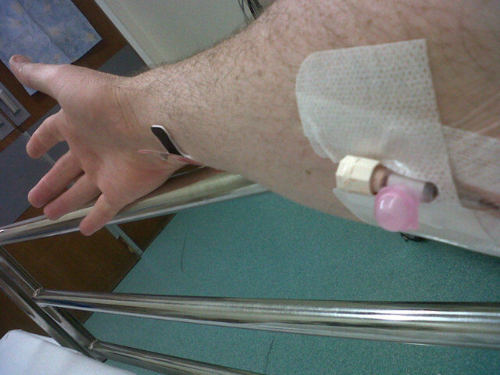
Because I am, otherwise, normally healthy, this is diagnosed as a panic attack. A severe one. Many questions are asked about the state of my mental health and I answer candidly, and because I’m waiting for an appointment with a counselling service, I’m discharged home. Physically feeling better. Definitely feeling more relieved ( I’m not dead!! ). But still feeling bad about what’s happened. Today I’ve been told by my GP that the panic attack was my body’s way of letting out the anxiety and depression that I’ve been bottling up, and that I need to start taking better care of myself or I’m heading for a breakdown and then what good would I be to me, or anyone? Then how bad would I feel?
Three things I miss terribly thanks to MS.
It’s not an exhaustive list, it’s just three that spring to mind.
Tomorrow marks a start of a big change. My wife has been granted what’s known as “recreational care” sessions ( care – small “c” change – get it?? Oh never mind… ). These are intended to give me respite from caring for a few hours at a time, letting someone else take charge for that short time. Two afternoons, twice a week. For now. It’ll also give us small breaks from each other. I mean, with the best will in the world, being together 24 hours a day is pretty soul destroying for us both. Not to mention very dangerous for our marriage. As I’ve written before, it feels like being married to the disease and not the person – such is its domination over our lives.
This means I can get some rest or more sleep. I can paint or listen to music or read a book. I can have a relaxing bath or get some exercise. But, knowing me, I’ll most likely do the usual, banal stuff and endlessly tweet about it!!! Anyhow, I’m free two afternoons a week for coffee, tea, small excursions, etc. Any ideas???
Despite the adverts that endeavour to make the subject of bladder incontinence acceptable, it’s not something you really want to contemplate having. It’s still something that gets giggled about when you’re with your mates in the pub, among friends at school or on comedy programmes ( the Little Britain sketches were NOT empowering in any way ). The adverts refer to “bladder leakage”. But what if you go from having the first feelings of needing to pee, to completely emptying your bladder inside two or three minutes? That’s a lot of pee. And a lot of clothes to change. And laundry to do.
Bladder incontinence is one of the more sensitive areas of MS. My wife not only has the bladder sensitivity that I described above but can also get the feeling of needing to pee, yet nothing happens when she gets to the toilet ( fellas with prostate issues know what I’m talking about, right? ). Let me describe what it takes to get my wife to the toilet. When we’re at home she sits in a reclinable chair so that helps in getting her upright but I have to lift her off the chair ( she can’t bear any weight on her legs ) and on to the wheelchair. I’ll wheel her to the bathroom where I have to lift her again to an upright position, turn her round – while holding her up with one arm, pull her trousers and incontinence pants down and set her on the toilet. All the while battling against powerful leg spasms that she can neither feel nor control ( damned lesions and nerve damage ). No mean feat! All this is done in reverse order to get her off the toilet, back on the wheelchair and back to the reclining chair in the front room. Each visit to the toilet requires me to lift her completely off the ground four times.
My wife weighs 45kgs ( give or take the odd biscuit or two ) and even at this light weight, taking her to the toilet is a fucking ordeal. Especially when you’re out somewhere and the bladder emptying strikes! Yesterday was a bit of an ordeal. Because my wife had a “feels-like-going-to-the-toilet-but-doesn’t-actually-go-much” day. She had to go to the toilet nine times. And at four lifts or “hoists” per visit, that’s 36 lifts to go to the toilet. Added to that 8 lifts first thing in morning to get her out of bed, showered and dressed, and 6 more at night to get her ready for, and into bed; I lifted her at least 50 times yesterday. Probably 10 – 16 more than usual. No wonder I’m knackered. I get cranky as hell about it. We both get frustrated about the whole deal and tears were shed. At least they were by me.
If I were in a humorous mood, I’d title this post “Bladder incontinence – takes the piss” or something equally drôle. But I’m not. I’m just tired and fed up. We both are.
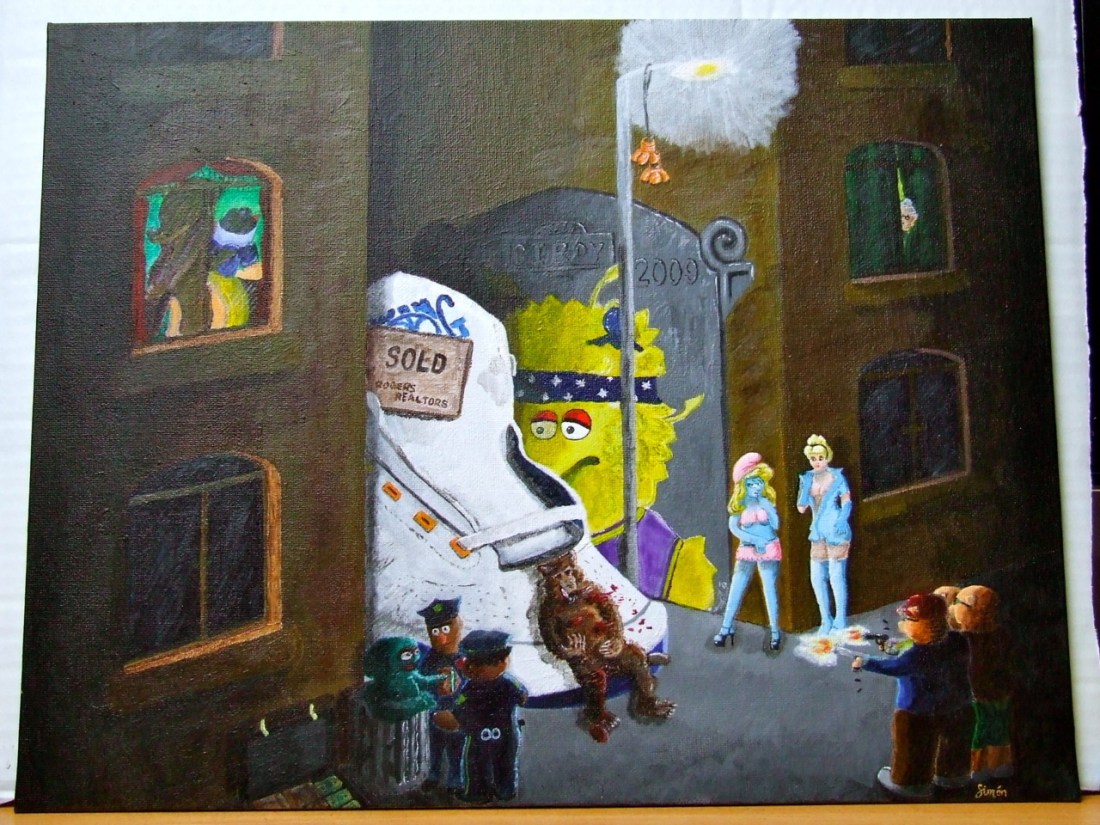
What do I do to keep myself from clawing the walls? ( other than the internet ) I paint. I mean I like to try to paint. On canvas, I’m not a decorator. The picture above is an example. The first picture I posted on here is another. I’m no Picasso or Miro but I enjoy doing it.
Time constraints of being a carer means that I’m not quick but I start with what image is in my head and I’ll carry on until the picture matches it. No matter how long it takes to complete.
This clip from Friends typifies what happens when I bump into someone I know who really doesn’t quite know what to say to me.
I feel I should take the time to explain a little more about why I started to write this blog. Its primary purpose is to give me an outlet, some catharsis, call it what you will. In other words, I get to let out the myriad thoughts, memories and feelings that keep spinning around in my head. My first post on this blog was a response to a particular trigger and the other posts have come to mind easily as they’re all strong memories or feelings for me. If you’re reading this then it won’t have any kind of coherent structure. I’m not writing a book, there’s no strict timeline here, just a jumble of words as they appear to me. I don’t have a set agenda, and everything you read here is genuine.
Here’s what I’m NOT looking to do:-
As a sort of quasi-therapy, blogging is definitely tough love ( When I cry it doesn’t offer me tissues *sniff* ). These posts are difficult to write because of the subject matter. But if I didn’t include the painful things, if it wasn’t warts ‘n’ all ( great phrase – who says the tabloid press aren’t educational ), there’d be no point doing it. I might as well not bother. Which means that a great deal of what I write can be a bit dark and depressing. I can’t apologise for that. Just as I can’t shy away from it. I will try to lighten the mood occasionally but I’ll be reflecting the mood that I’m in while I’m writing.
So…… I get really *really* nervous whenever I post something new but I hope this tells you a little more about the what and why. And with that, thanks for reading.
In my last syrupy offering, I wrote about the importance of a social network – including but not limited to online networks. I also said I’d expand on the feelings of isolations that can be felt by carers. Here goes…
Today, for the first time, I spoke on the phone with a friend that I’ve only communicated with online. This friend has MS. This friend is also a carer. This friend has just suffered the bereavement of somebody vitally important to them. The loving relationship between my friend and the person they lost was the most important connection between them. But the death also meant my friend lost a big piece of the small network of support they have which helps them cope with their many daily struggles. My friend is so good at managing their own condition plus managing another condition as a carer. However, today’s conversation gave me the over-riding feeling that my friend feels incredibly isolated while trying to contend with everything on a daily basis. Their bereavement has knocked them out of kilter and they’re struggling to re-gain the strength they’ve shown in dealing with the hardships that life has brought them for some years. I hope I was able to give some kind of comfort. I’ll return to my friend later.
After listening to my friend, I couldn’t help but remember my own experiences of isolation. Our conversation revealed many parallels in our lives. Prior to my wife being diagnosed with MS, we both worked for the same department in the Civil Service. We had a circle of friends (albeit they’d known my wife longer than me) with whom we’d socialise on a regular basis. When we gave them the news of a diagnosis of MS, they were initially supportive. A lot of them told us the same thing, “If you need anything, just ask us – even if it’s just a chat”. Disabled people and carers all over the world will have heard this statement or something similar. And I’m sure you know which of your friends you can rely on for that kind of help. What I wasn’t prepared for were the people who I thought were good friends who sank without trace. One particular couple from this circle worked in the same building as we did. They’d park their car near our home, which was only 10 minutes’ walk from the office. We’d have a drink, have a laugh, etc. – the usual things you do with friends. After we told them of my wife’s diagnosis, this couple would still park their car near our home. Yet they’d pass our home twice a day and never knock. They came in to see my wife only once. And that was because they’d passed the house while I was standing on the step waiting for a supermarket shopping delivery. I think they felt shamed into asking to see her. We saw more instances of this kind of boycott during the first year after my wife’s diagnosis. I can’t tell you how angry I’d get. I wasn’t bothered about them coming to see me but my wife was suffering greatly after her diagnosis. How could they do this to her? What sort of friends were they anyway? To abandon her at the first sign of adversity? As the years have passed, I’ve learned to recognised who can and can’t be relied on.
But this behaviour isn’t limited only to “friends”. I was telling the story of the boycotting friends to my family during a get-together. Amid much head-shaking and tutting, I was encouraged to move back to where I’d grown up. I remember vividly the words said to me by one in particular, “Don’t worry, we’ll support you." Support. We were desperate for support. During the three years we lived near them, we saw my family……… twice. Twice. Three times if you include bumping into them in a town centre. You can choose your friends, but you expect more from family surely? I was tired of being let down. I felt very responsible because it was my family who’d promised much and delivered little. This did nothing to improve my increasingly cynical view of people in general. My wife and I were both pretty miserable living there despite the fact that the house we lived in was ideal and that we had breathtaking views from the windows. We decided that we’d move somewhere that would suit us as we’re both "city” people.
Which brings me to the importance of social interaction. I won’t repeat everything from my last post – you can read here the effect that Twitter and the internet in general have had on my life. I want to say this to my friend (who I’m sure will recognise themselves from the first paragraph) : you have so much to confront every day and you cope with it with smiles and love. You face down indescribable challenges with smiles and love. YOU are one of those inspirational people that you spoke about. But you must look after yourself too. Every once in a while, you must be selfish because, if you’re not, you’ll damage yourself. I’m going to tell you something that you’ve heard before – if you need anything, even a chat, just ask. And, because I know what you face, I mean it.
I ran this post past my friend prior to releasing it and she’s happy for me to tell you about her website for her son’s condition – Ring 14.
EDIT: 15.55 25/06 – I feel it’s important to point out that the one family member that was outstanding was my Mother. But, as she’s in her 70s, there is a limit to what she can do. Besides, not being near her now means she can live her life as she sees fit.
 A Husband For A Carer